
Worksheet: How Electromagnetic Waves Transmit Music, Messages, & More
Comprehension worksheet generated from the video "How Electromagnetic Waves Transmit Music, Messages, & More".
Worksheet: How Electromagnetic Waves Transmit Music, Messages, & More
JaxDoc

Vocabulary
- Frequency — Describes how many electromagnetic waves pass a given point in a second, measured in Hertz (Hz).
- Wavelength — The distance from the crest of one wave to another.
- Amplitude — Refers to the maximum distance from the rest position to the top of a wave’s crests or the lowest point in a trough.
- Phase — Describes the relationship between the position of the amplitude crests and troughs of two waves with the same frequency and wavelength.
- Modulation — The process of varying a property of a high-frequency carrier signal in accordance with a message signal to transmit data.
Questions
Watch the video carefully and answer the following questions based on the information presented.
1.
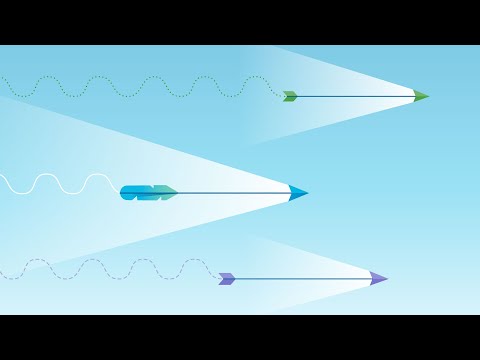
The video uses an analogy to explain the difficulty of transmitting electromagnetic waves without modulation. Describe this analogy and what it represents.
2.
According to the video, what is the key difference in how AM (Amplitude Modulation) and FM (Frequency Modulation) radio stations transmit their messages?
3.
The video introduces the term MODEM. What does MODEM stand for, and what is its primary function in the context of digital data transmission?
4.
Which of the following is NOT explicitly mentioned as a type of digital modulation (shift-keying) in the video?
5.
The video concludes by comparing modern digital data transmission to old-school telegraph technology, stating, “We’ve just gotten a bit more high-tech since then.” Analyze the similarities and differences in how information is encoded and transmitted in both systems, and explain why modern methods are considered more “high-tech” based on the video’s content.
Want materials like this for your lessons?
Jax builds worksheets, study guides, and lesson materials for whatever you're teaching. Free to start, no card needed.