
Worksheet: Analog vs. Digital Signals Lesson
Comprehension worksheet generated from the video "Analog vs. Digital Signals Lesson".
Worksheet: Analog vs. Digital Signals Lesson
JaxDoc

Vocabulary
- Signal — A quantity that can represent and convey information, typically passed between devices.
- Analog signal — A signal that converts information into continuous waves of varying amplitude and frequency.
- Digital signal — A signal that converts information into discrete ON (1) or OFF (0) pulses, also known as binary.
- Binary — A system of information representation using only two possible values, typically 1 (ON) or 0 (OFF).
- ADC (Analog to Digital Converter) — A device that samples an unfiltered analog signal to convert it into a sampled digitized signal.
Questions
Watch the video carefully and answer the following questions based on the information presented.
1.
According to the video, what is a signal, and how is it typically used?
2.
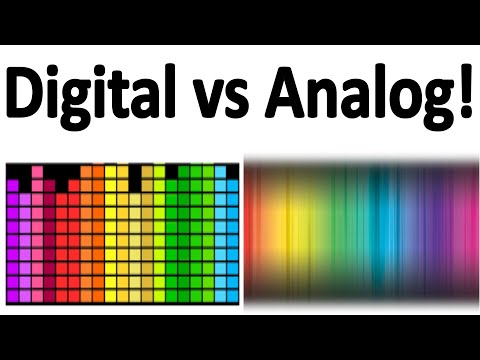
At 1:19, the video shows two graphs representing an analog signal and a digital signal. Describe the visual difference between these two types of signals as depicted in the graphs.
3.
Explain the process described in the video (3:14) for converting a singer’s analog voice into a digital MP3 song that can be played on a phone.
4.
The video explains that when you speak into a cell phone, your analog voice is converted into digital signals. What happens to these digital signals before the listener receives them, and why?
5.
The video concludes by posing several research questions about analog and digital signals. Choose three of these questions and, based on what you learned in the video and your own reasoning, discuss how analog and digital signals might compare in relation to these chosen aspects.
Want materials like this for your lessons?
Jax builds worksheets, study guides, and lesson materials for whatever you're teaching. Free to start, no card needed.