

Worksheet: Division with remainders as fractions
Comprehension worksheet generated from the video "Division with remainders as fractions".
Worksheet: Division with remainders as fractions
JaxDoc
Vocabulary
- Remainder — The amount left over after a division problem when the divisor does not divide the dividend evenly.
- Fraction — A way to express a part of a whole, shown as one number (numerator) over another (denominator).
- Divide — To split a number into equal parts.
- Denominator — The bottom number of a fraction, representing the total number of equal parts.
Questions
Watch the video “Division: Leaving Remainders as Fractions” and answer the following questions based on the information presented in the video.
1.
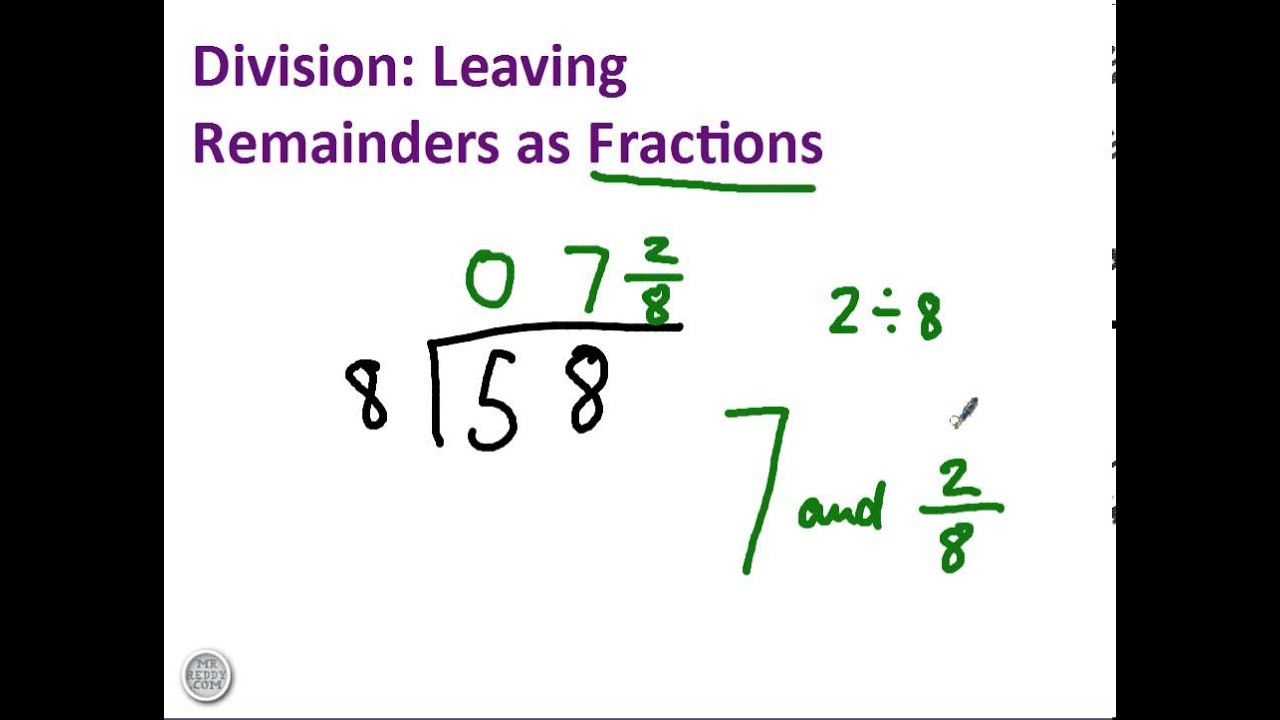
According to the video, what is the first division problem demonstrated, and what is its remainder when initially calculated?
2.
For the division problem , the video explains how to convert the remainder into a fraction. What is the fractional part of the answer?
3.
In the last example, , what is the final answer expressed as a mixed number?
4.
When leaving a remainder as a fraction, as explained in the video, where does the original divisor go in the fraction?
5.
The video states that leaving remainders as fractions is a “more sophisticated way” to express answers than using “r.” (remainder). Explain why this is the case, using one of the examples from the video to illustrate your point.
Want materials like this for your lessons?
Jax builds worksheets, study guides, and lesson materials for whatever you're teaching. Free to start, no card needed.


