
Worksheet: Computational Thinking: What Is It? How Is It Used?
Comprehension worksheet generated from the video "Computational Thinking: What Is It? How Is It Used?".
Worksheet: Computational Thinking: What Is It? How Is It Used?
JaxDoc

Computational ThinkingCollege & Career Ready Labs │ Paxton Pattersonhttps://www.youtube.com/watch?v=qbnTZCj0ugI
Vocabulary
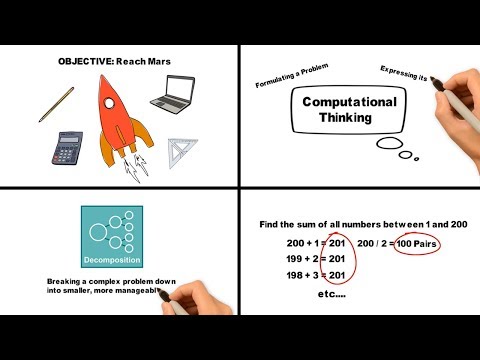
- Computational Thinking — The thought process involved in formulating a problem and expressing its solution in a way that a computer, human, or machine can effectively carry it out.
- Decomposition — Breaking a complex problem down into smaller, more manageable parts.
- Pattern Recognition — Identifying patterns or trends within a problem.
- Abstraction — Identifying specific similarities and differences among similar problems to work toward a solution.
- Algorithm Design — Developing step-by-step instructions for solving a problem, which can be used again to solve similar problems.
Questions
Watch the video carefully and answer the following questions based on the information presented.
1.
According to the video, what is the first step of Computational Thinking, and how is it demonstrated using the problem of finding the sum of numbers between 1 and 200?
2.
Explain the concept of Pattern Recognition as applied to the “sum of numbers between 1 and 200” problem in the video. What specific pattern was identified?
3.
Describe how Abstraction was used in the video to simplify the “sum of all numbers between 1 and 200” problem. What was the resulting simplified expression?
4.
Which of the following is NOT one of the four steps of Computational Thinking described in the video?
5.
The video demonstrates an algorithm to find the sum of all numbers between 1 and . Apply this algorithm to find the sum of all numbers between 1 and 500. Clearly explain each step of the algorithm (Decomposition, Pattern Recognition, Abstraction, and Algorithm Design) as you would use it to solve this new problem.
Want materials like this for your lessons?
Jax builds worksheets, study guides, and lesson materials for whatever you're teaching. Free to start, no card needed.