
Worksheet: Logistic growth versus exponential growth | Ecology | AP Biology | Khan Academy
Comprehension worksheet generated from the video "Logistic growth versus exponential growth | Ecology | AP Biology | Khan Academy".
Worksheet: Logistic growth versus exponential growth | Ecology | AP Biology | Khan Academy
JaxDoc
Vocabulary
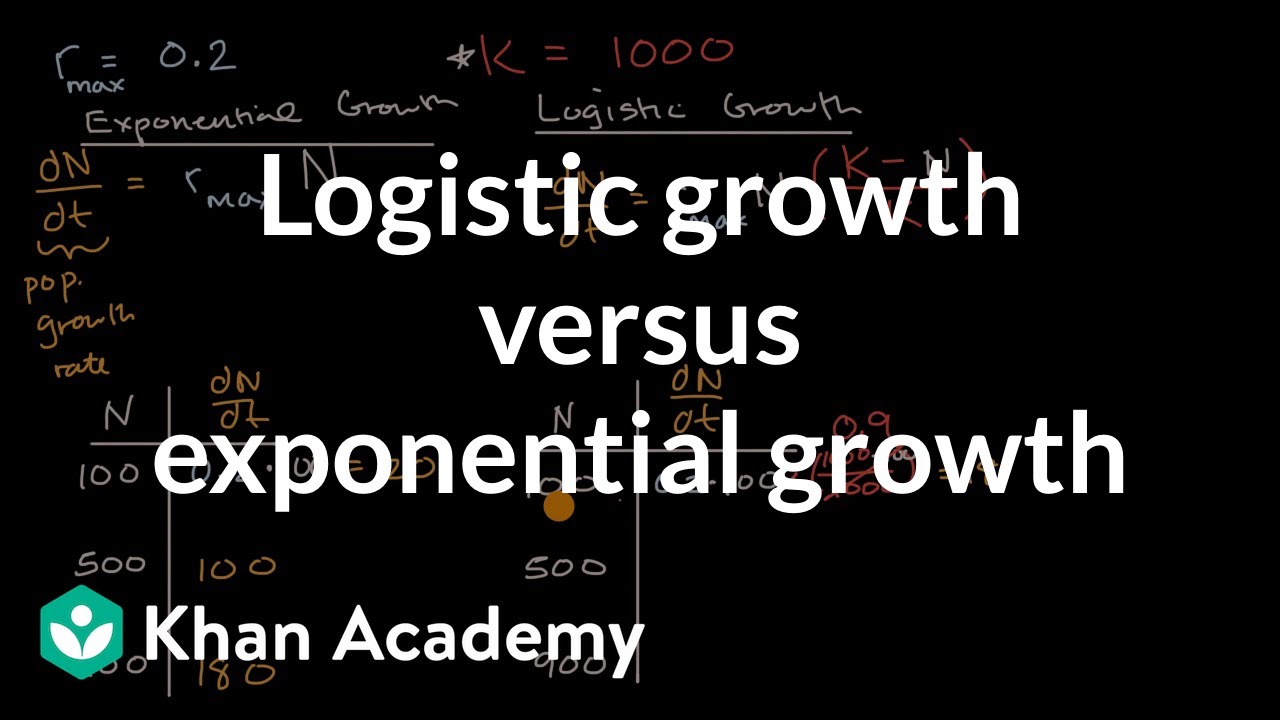
Per capita growth rate® — The average growth rate per individual in a population.Maximum per capita growth rate() — The per capita growth rate of a population when it is not limited by resources or environmental factors.Exponential growth— A type of population growth where the rate of change is directly proportional to the current population size, assuming unlimited resources.Carrying capacity(K) — The maximum population size of a biological species that can be sustained indefinitely by a given environment.Logistic growth— A type of population growth that accounts for environmental limits and carrying capacity, causing the growth rate to slow down as the population approaches K.
Questions
Watch the video and answer the following questions based on the information presented.
1.
If the
per capita growth rate ® for a population is , what does this mean for the population’s growth? (Refer to 0:13-0:29)2.
The video introduces the
exponential growth equation as . If is and the population is , what is the population growth rate ()? (Refer to 1:30-2:14)3.
What term is used to describe the maximum number of individuals an environment can support, and what letter represents it in the
logistic growth equation? (Refer to 4:10-4:39)4.
In the
logistic growth equation, , what does the factor represent? (Refer to 4:50-5:38)5.
Compare and contrast
exponential growth and logistic growth as depicted in the video’s graph (8:50-10:00). Explain why logistic growth is generally considered a more realistic model for most populations.Want materials like this for your lessons?
Jax builds worksheets, study guides, and lesson materials for whatever you're teaching. Free to start, no card needed.