
Worksheet: Pythagorean Theorem and Distance Formula
Comprehension worksheet generated from the video "Pythagorean Theorem and Distance Formula".
Worksheet: Pythagorean Theorem and Distance Formula
JaxDoc

Vocabulary
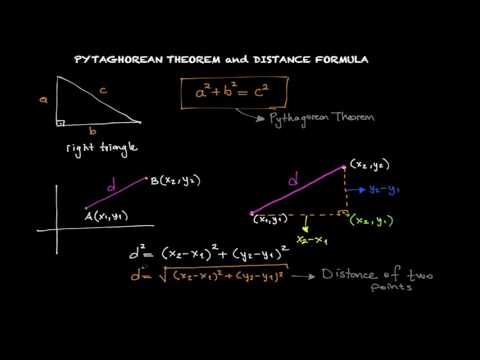
- Pythagorean Theorem — A theorem stating that in a right triangle, the square of the hypotenuse () is equal to the sum of the squares of the two legs ().
- Right Triangle — A triangle that has one angle measuring 90 degrees.
- Hypotenuse — The side opposite the right angle in a right triangle, which is always the longest side.
- Legs — The two sides of a right triangle that form the right angle.
- Cartesian Plane — A two-dimensional coordinate system used to locate points using ordered pairs .
Questions
Watch the video and answer the following questions based on the content presented.
1.
According to the video at 0:28, what is the mathematical relationship between the legs
a and b, and the hypotenuse c in a right triangle?2.
When deriving the distance formula at 1:55, what expressions represent the lengths of the horizontal and vertical legs of the right triangle formed by points and ?
3.
In the first example (3:24), after calculating the distance between points and , what is the final simplified distance obtained?
4.
In the second example (5:14), which point is identified as the vertex where the right angle is located in the triangle formed by , , and ?
5.
Explain in your own words how the Pythagorean Theorem is used to derive the Distance Formula for two points on a Cartesian plane. Describe the role of each component () in forming a right triangle.
Want materials like this for your lessons?
Jax builds worksheets, study guides, and lesson materials for whatever you're teaching. Free to start, no card needed.