

Worksheet: Solving Rational Equations
Comprehension worksheet generated from the video "Solving Rational Equations".
Worksheet: Solving Rational Equations
JaxDoc
Vocabulary
- Rational equation — An equation involving fractions where the numerator and/or denominator contain variables.
- Least Common Multiple (LCM) — The smallest positive integer that is a multiple of two or more given integers, used to clear fractions in an equation.
- Cross-multiply — A method used to solve equations involving two fractions set equal to each other, by multiplying the numerator of one fraction by the denominator of the other.
- Factor — To express a polynomial as a product of two or more polynomials.
Questions
Watch the video carefully and answer the following questions based on the content presented.
1.
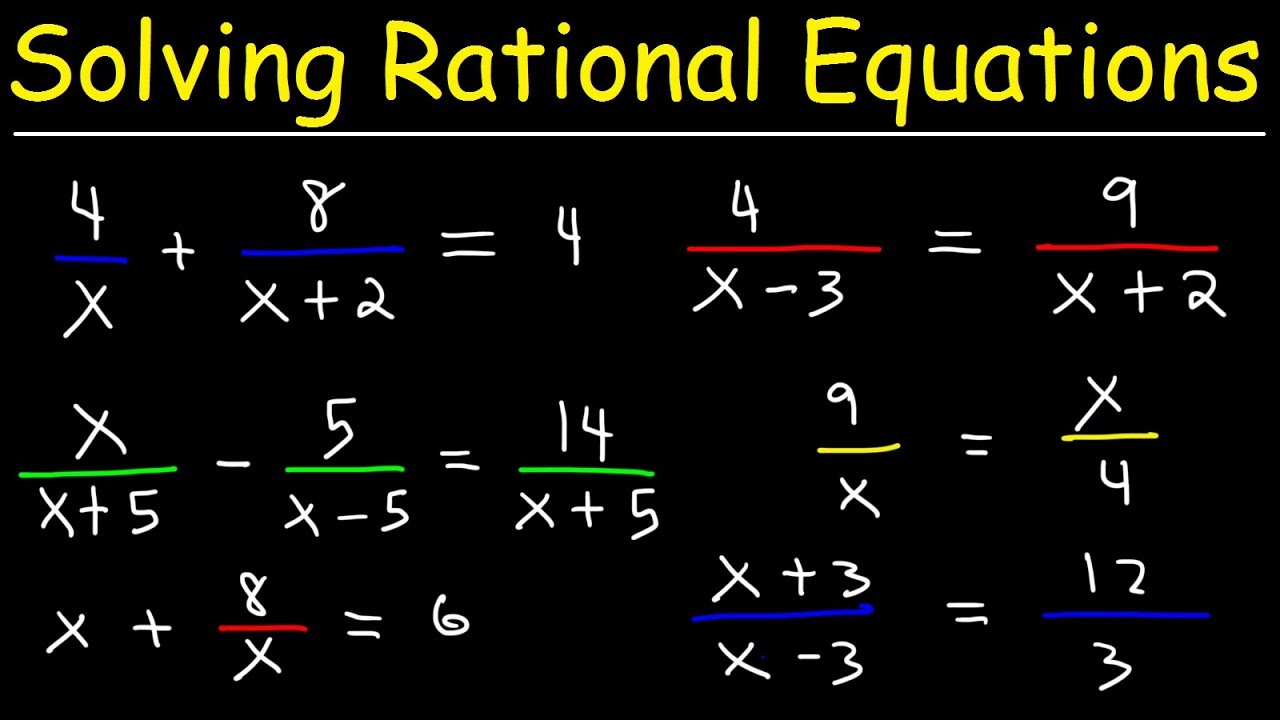
Based on the first example shown in the video (at 0:06, ), what was the first step the narrator took to solve the equation, and why was it effective?
2.
In the second example (at 1:47, ), the equation was transformed into a quadratic equation. What were the two solutions for
x after factoring?3.
For the equation (shown at 3:46), the narrator used a specific method to solve it. Describe this method and state the final answer(s).
4.
In the final example (at 8:40), , what was the least common multiple (LCM) used to clear the fractions?
5.
Reflect on the different strategies presented in the video for solving rational equations (e.g., finding the LCM, cross-multiplication, factoring quadratic equations). When might each strategy be most appropriate, and why is it important to be familiar with multiple approaches?
Want materials like this for your lessons?
Jax builds worksheets, study guides, and lesson materials for whatever you're teaching. Free to start, no card needed.


